Current Refinance Rates on March 13, 2024: Rates Decline for Homeowners 29 minutes ago
Like 1 Avatar config id=1 Typo writer Date of creation: March 13, 2024, 2:06 p.m.
Original page link
Category: Finance
Tags: refinance, custom quote, pay off house faster, credit history, long-term savings, consistent payments, monthly mortgage payments, 10-year fixed refinance, financial goals, 30-year fixed refi, lower refinance rates, homeowners, 10-year fixed refi, interest rate cuts, slowing inflation, higher monthly payments, application, home loan, 15-year fixed refi, high credit score, current mortgage rates, 15-year refinance rates, mortgage interest rates, mortgage refinance rates, federal reserve, on-time payments, save on interest, lower monthly payments, longer loan term, financial profile, more interest paid, strong application, low credit utilization ratio, multiple lenders
Tags2: financial profile, credit history, mortgage refinance rates, 10-year fixed refinance, federal reserve, interest rate cuts, homeowners, application, refinance, custom quote, pay off house faster, long-term savings, consistent payments, monthly mortgage payments, financial goals, 30-year fixed refi, lower refinance rates, 10-year fixed refi, slowing inflation, higher monthly payments, home loan, 15-year fixed refi, high credit score, current mortgage rates, 15-year refinance rates, mortgage interest rates, on-time payments, save on interest, lower monthly payments, longer loan term, more interest paid, strong application, low credit utilization ratio, multiple lenders
Avatar post content:
Introducing Lower Refinance Rates for Homeowners: Current Mortgage Rates on March 13, 2024
Are you a homeowner looking to reduce your monthly mortgage payments? Now is the perfect time to refinance! With current rates ranging from 6.5% to 7.5%, you have the opportunity to save money on your home loan. However, it's important to note that your personal interest rate will depend on factors such as your credit history, financial profile, and application.
Let's take a closer look at the current refinance rates:
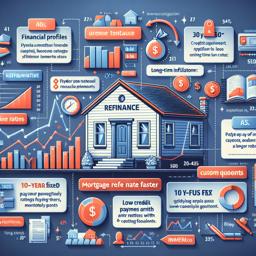
- 30-year fixed refi: 6.84% (down 0.20% from last week)
- 15-year fixed refi: 6.49% (down 0.12% from last week)
- 10-year fixed refi: 6.32% (down 0.15% from last week)
By shopping around and comparing rates from multiple lenders, you can ensure that you're getting the lowest rate possible. Enter your information below to receive a custom quote from one of our trusted partner lenders.
It's important to understand that these rates are subject to change as mortgage refinance rates fluctuate daily. To secure the best refinance rates, it's crucial to have a strong application. This includes having a high credit score, low credit utilization ratio, and a history of consistent and on-time payments. Taking these steps will help you secure the most favorable interest rates.
Refinancing your mortgage offers several benefits depending on your financial goals. If you're looking to lower your monthly payments, a 30-year fixed refinance may be the best option for you. However, keep in mind that this will result in a longer loan term and potentially more interest paid over time.
On the other hand, a 15-year fixed refinance will increase your monthly payments but save you more money in the long run by paying off your loan quicker. Additionally, 15-year refinance rates are typically lower than 30-year refinance rates, providing more long-term savings.
If you're looking to pay off your house faster and save on interest, a 10-year fixed refinance may be the best choice. However, it's important to ensure that you can comfortably afford the higher monthly payments associated with this option.
Looking ahead, experts predict that mortgage interest rates will decrease to around 6% by the end of 2024 due to slowing inflation and projected interest rate cuts by the Federal
Original page content Rates Decline for Homeowners. Current Refinance Rates on March 13, 2024 | Current mortgage refinance rates Refinance rates are currently between 6.5% and 7.5%, but your personal interest rate will depend on your credit history, financial profile and application. Product Rate A week ago Change 30-year fixed refi 6.84% 7.04% -0.20 15-year fixed refi 6.49% 6.61% -0.12 10-year fixed refi 6.32% 6.47% -0.15 Average refinance rates reported by lenders across the US as of March 13, 2024. We track refinance rate trends using information from Bankrate. Mortgage refinance rates change every day. Experts recommend shopping around to make sure you’re getting the lowest rate. By entering your information below, you can get a custom quote from one of CNET’s partner lenders. About these rates: Like CNET, Bankrate is owned by Red Ventures. This tool features partner rates from lenders that you can use when comparing multiple mortgage rates. How to find the best refinance rates The rates advertised online often require specific conditions for eligibility. Your personal interest rate will be influenced by market conditions as well as your specific credit history, financial profile and application. Having a high credit score, a low credit utilization ratio and a history of consistent and on-time payments will generally help you get the best interest rates. 30-year fixed-rate refinance The average 30-year fixed refinance rate right now is 6.84%, a decrease of 20 basis points over this time last week. (A basis point is equivalent to 0.01%.) A 30-year fixed refinance will typically have lower monthly payments than a 15-year or 10-year refinance, but it will take you longer to pay off and typically cost you more in interest over the long term. 15-year fixed-rate refinance The current average interest rate for 15-year refinances is 6.49%, a decrease of 12 basis points from what we saw the previous week. Though a 15-year fixed refinance will most likely raise your monthly payment compared to a 30-year loan, you’ll save more money over time because you’re paying off your loan quicker. Also, 15-year refinance rates are typically lower than 30-year refinance rates, which will help you save more in the long run. 10-year fixed-rate refinance The average 10-year fixed refinance rate right now is 6.32%, a decrease of 15 basis points over last week. A 10-year refinance typically has the lowest interest rate but the highest monthly payment of all refinance terms. A 10-year refinance can help you pay off your house much quicker and save on interest, but make sure you can afford the steeper monthly payment. To get the best refinance rates, make your application as strong as possible by getting your finances in order, using credit responsibly and monitoring your credit regularly. And don’t forget to speak with multiple lenders and shop around. Current refinance rate trends Refinance rates dropped significantly toward the end of 2023, bringing much-needed activity to the housing market. Since early February, however, rates have climbed back into the 7% range. The increase came after recent inflation and labor data made it clear to investors that the Federal Reserve won’t start cutting interest rates until early this summer. Higher mortgage rates make refinancing less attractive to homeowners, making them more likely to hold on to their existing mortgages. 30-year fixed refinance: 6.84% 15-year fixed refinance: 6.49% 10-year fixed refinance: 6.32% What to expect from refinance rates this year Experts say slowing inflation and the Fed’s projected interest rate cuts should help push mortgage interest rates down to around 6% by the end of 2024, but that will depend on incoming economic data. Over 82% of homeowners currently have interest rates below 5% on their property. If home loan rates stabilize over the next several months, more homeowners should be able to save money through refinancing. Yet in order for refinance applications to pick up in a meaningful way, rates would need to fall substantially, according to Mark Zandi, chief economist at Moody’s Analytics. For homeowners looking to refinance, remember that you can’t time the market: Interest rates fluctuate on an hourly, daily and weekly basis, and are influenced by an array of macroeconomic factors. Your best move is to keep an eye on day-to-day rate changes and have a game plan on how to capitalize on a big enough percentage drop, said Matt Graham of Mortgage News Daily. What does it mean to refinance? When you refinance your mortgage, you take out another home loan that pays off your initial mortgage. With a traditional refinance, your new home loan will have a different term and/or interest rate. With a cash-out refinance, you’ll tap into your equity with a new loan that’s bigger than your existing mortgage balance, allowing you to pocket the difference in cash. Refinancing can be a great financial move if you score a low rate or can pay off your home loan in less time, but consider whether it’s the right choice for you. Reducing your interest rate by 1% or more is an incentive to refinance, allowing you to cut your monthly payment significantly. Refinancing in today’s market could make sense if you have a rate above 8%, said Logan Mohtashami, lead analyst at HousingWire. “However, with all refinancing options, it’s a personal financial choice because of the cost that goes with the loan process,” Mohtashami said. When to consider a mortgage refinance Homeowners usually refinance to save money, but there are other reasons to do so. Here are the most common reasons homeowners refinance: To get a lower interest rate: If you can secure a rate that’s at least 1% lower than the one on your current mortgage, it could make sense to refinance. To switch the type of mortgage: If you have an adjustable-rate mortgage and want greater security, you could refinance to a fixed-rate mortgage. To eliminate mortgage insurance: If you have an FHA loan that requires mortgage insurance, you can refinance to a conventional loan once you have 20% equity. To change the length of a loan term: Refinancing to a longer loan term could lower your monthly payment. Refinancing to a shorter term will save you interest in the long run. To tap into your equity through a cash-out refinance: If you replace your mortgage with a larger loan, you can receive the difference in cash to cover a large expense. To take someone off the mortgage: In case of divorce, you can apply for a new home loan in just your name and use the funds to pay off your existing mortgage. Recommended Articles Compare Current Refinance Rates in March 2024 Compare Current Refinance Rates in March 2024 By David McMillin Refinancing a Mortgage: How It Works Refinancing a Mortgage: How It Works By David McMillin 30-Year Refinance Rates for March 2024 30-Year Refinance Rates for March 2024 By Alix Langone 15-Year Mortgage Refinance Rates for March 2024 15-Year Mortgage Refinance Rates for March 2024 By Alix Langone How to Refinance Your Home How to Refinance Your Home By Dori Zinn How Does a Cash-Out Refinance Work? How Does a Cash-Out Refinance Work? By Amanda Push VA Refinance Rates for March 2024 VA Refinance Rates for March 2024 By Alix Langone